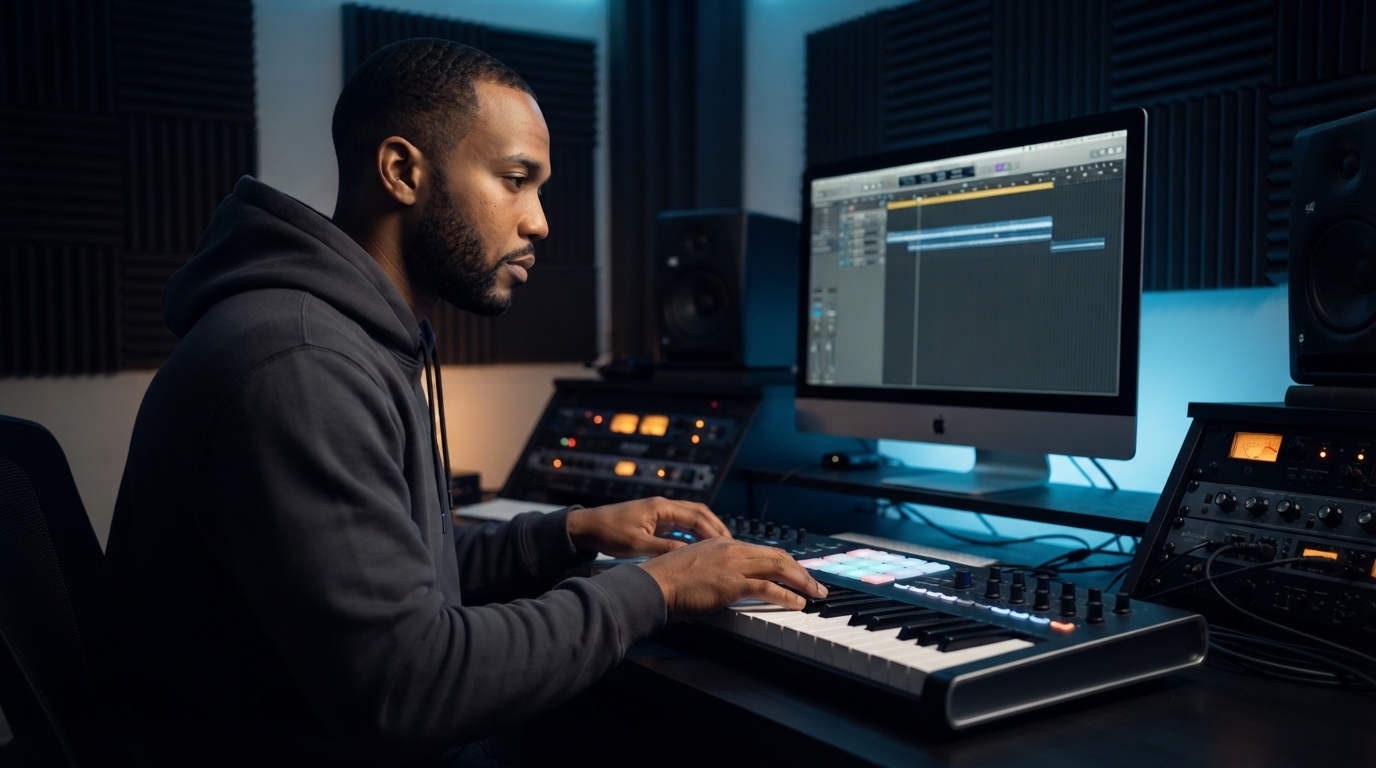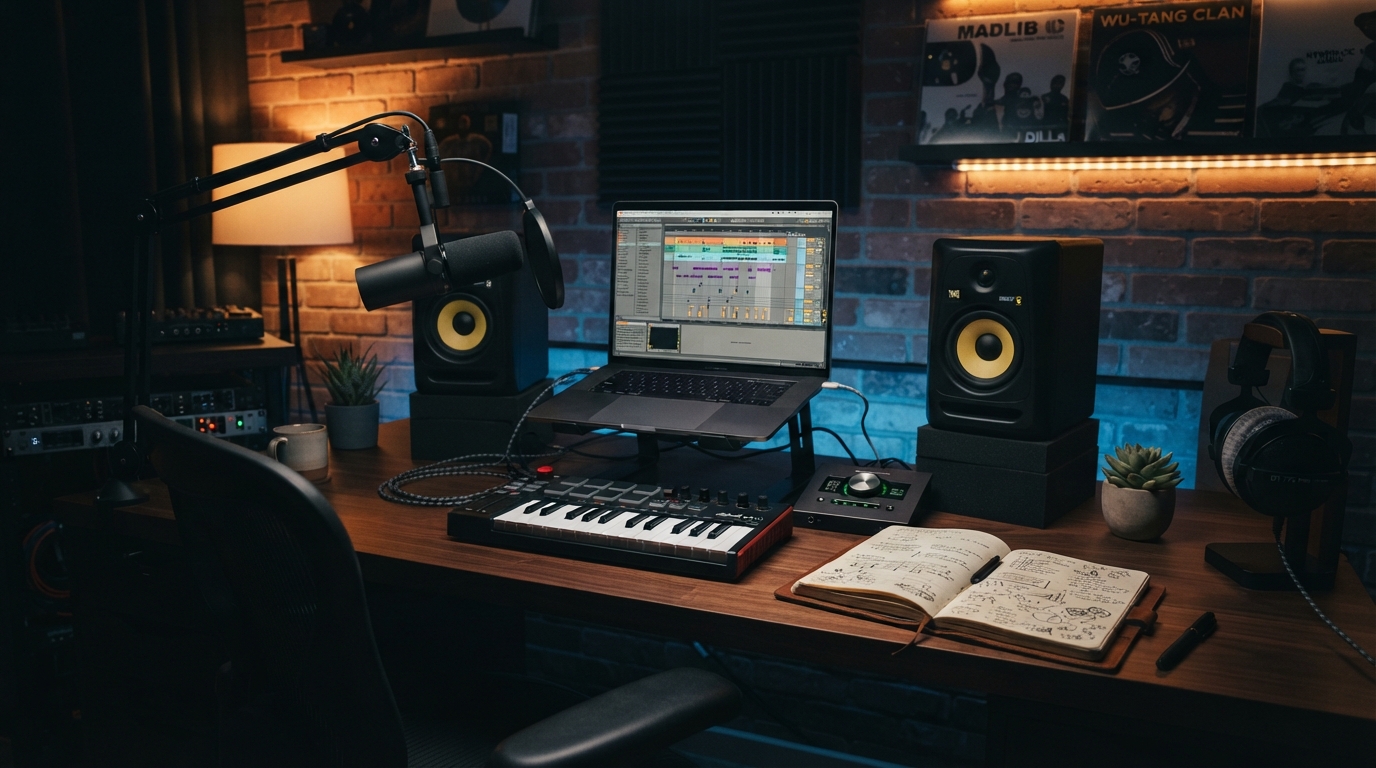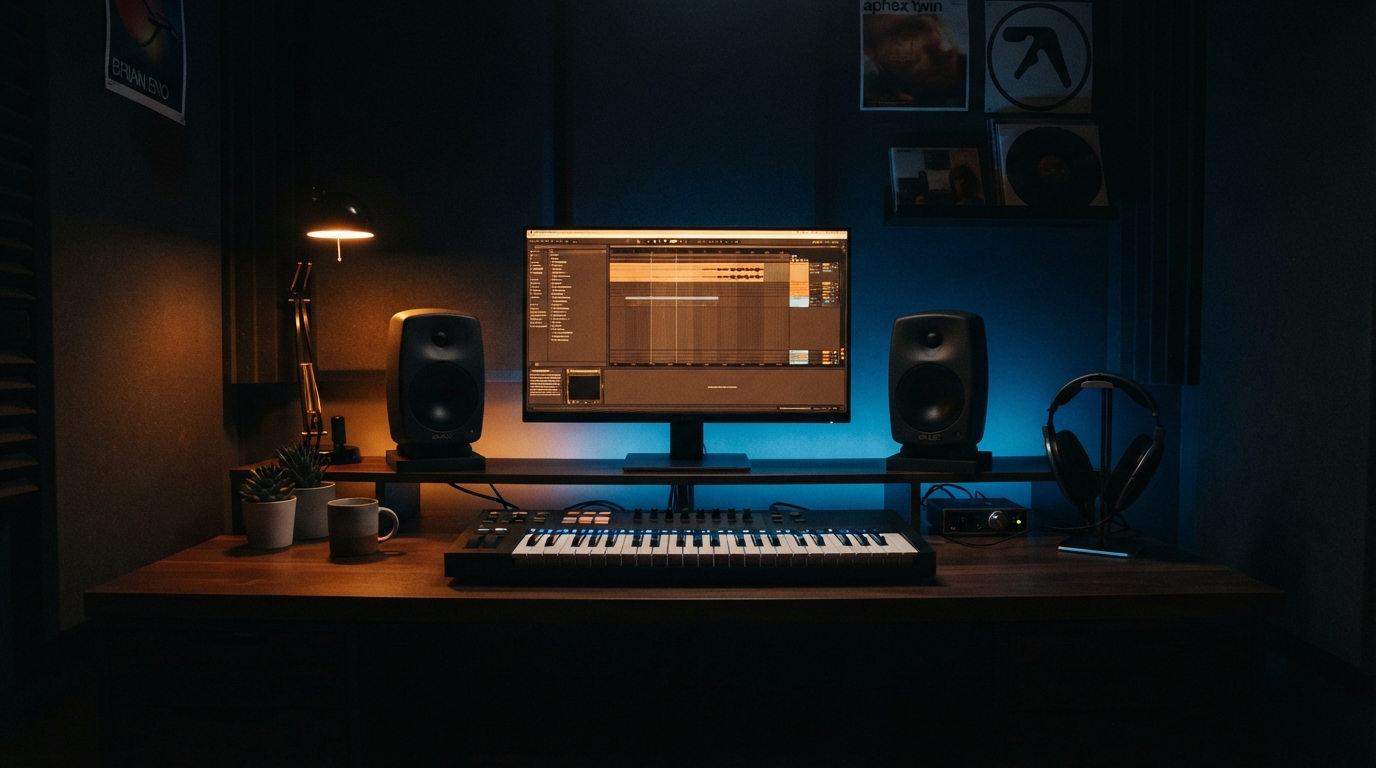
When you are locked into a late-night session crafting verses and producing beats, the speakers on your desk dictate the truth of your sound. In a small home studio or bedroom creative sanctum, regular commercial speakers or poorly calibrated hi-fi setups flatter your ears with artificial bass boosts and hyped highs. While that might feel satisfying in the moment, it leads to muddy mixes, masked vocal lines, and tracks that fall apart the moment they are played in a car or on club sound systems.
A true pair of nearfield studio monitors does not exist to make your music sound pretty—it exists to tell you the unvarnished acoustic truth. For lyrical analysts and producers, precise nearfield monitors expose subtle frequency collisions between kick drums and basslines, reveal unwanted vocal plosives, and let you place every syllable and ad-lib with surgical spatial accuracy.
In our foundational guide to building an acoustic home studio sanctum and our breakdown of the best studio monitor headphones for critical listening, we emphasize that accurate reference monitoring is the cornerstone of professional music production. Today, I am sharing our curated 2026 buyer’s guide featuring the top 5 desktop studio monitors optimized specifically for small rooms and compact home workspaces.
| Affiliate Disclosure: As an Amazon Associate, W. Ren Peace earns from qualifying purchases. When you purchase through links on our site, we may earn an affiliate commission at no extra cost to you. |
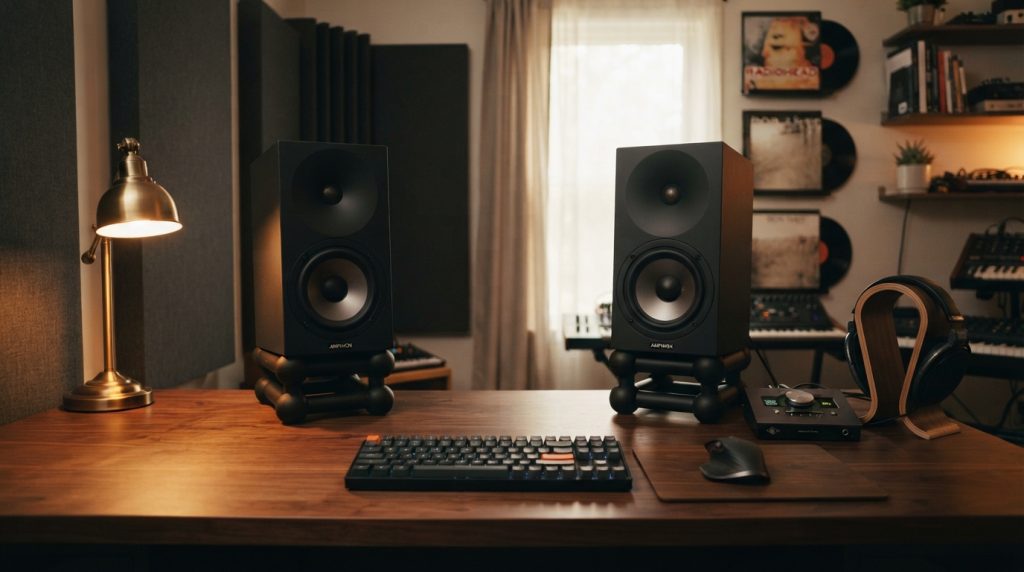
The Quick Edit / Quick List
- The Industry Truth Standard (Best Overall Reference): Yamaha HS5 Powered Studio Monitors
- The DSP Room-Correction Master (Best for Untreated Rooms): KRK Rokit 5 G4 Studio Monitors
- The Ultra-Wide Sweet Spot (Best Soundstage Waveguide): JBL 305P MKII Studio Monitors
- The Deep Bass Precision Pick (Best Extended Low-End): Kali Audio LP-6 V2 2nd Wave
- The Budget Bedroom Favorite (Best Value Nearfield): PreSonus Eris E5 XT Studio Monitors
What to Look for When Choosing: Expert Buyer’s Guide
- Woofer Driver Size (5-Inch Sweet Spot): In small, untreated, or semi-treated rooms (under 150 sq ft), 5-inch woofers are the ideal sweet spot. They provide tight, punchy, and articulate bass response down to 50 Hz without overloading small room modes with uncontrollable sub-bass standing waves that 8-inch monitors often create.
- Acoustic Space & Boundary EQ Controls: When desktop monitors are placed near walls or corners, boundary bass buildup can muddy your midrange. Look for monitors with rear-panel DIP switches or onboard DSP room-tuning filters (such as Room Control, Boundary EQ, and High Trim) to counteract reflective wall surfaces.
- Port Placement (Front vs. Rear Bass Reflex Ports): If your studio desk must sit flush against a wall, front-ported monitors or rear-ported monitors with dedicated boundary compensation switches allow clean airflow without booming reflections off the drywall.
- Waveguide Design and Sweet Spot Dispersion: A well-engineered high-frequency waveguide creates a wide, consistent listening sweet spot across your desk, ensuring accurate stereo imaging and phantom center vocal placement even when you shift positions in your chair.
Top Curated Picks & In-Depth Reviews
1. Yamaha HS5 Powered Studio Monitors (Pair)
Best Overall Nearfield Reference for Critical Mixing
The iconic white-cone Yamaha HS5 is the modern descendant of the legendary NS-10M. Designed for ruthless honesty, the HS5 features a 5-inch cone woofer and a 1-inch dome tweeter driven by a dedicated 70W bi-amp amplification system. It delivers an uncompromisingly flat, analytical midrange that forces you to fix vocal masking, harsh sibilance, and balance issues upfront. If your mix translates clearly on the HS5, it will translate everywhere.
Key Benefits for Creators: Provides extreme midrange transparency, making vocal levelling, sibilance editing, and instrument placement effortless. The rigid cabinet design minimizes internal resonances for clean, uncolored output.
Small Room Placement Tip: Position the HS5s at least 1.5 feet away from back walls, and set the rear Room Control switch to -2dB or -4dB under 500Hz to eliminate low-end boundary buildup in tight desk setups.

Yamaha HS5 Powered Studio Monitors
The industry standard for ruthless analytical mixing clarity and uncompromising midrange honesty.
Key Highlights & Considerations
Pros:
- Legendary flat and analytical frequency response with surgical midrange clarity
- Room Control (-2dB/-4dB under 500Hz) and High Trim (+/-2dB) rear acoustic switches
- Rock-solid MDF cabinet construction with specialized three-way mitered joint design
- Distinctive aesthetic with illuminated Yamaha badge and iconic white cone
Cons:
- Bass rolls off steeply below 54Hz; may require a subwoofer for deep 808 sub-bass checking
2. KRK Rokit 5 Generation 4 (G4) Powered Studio Monitors
Best DSP-Tuned Studio Monitors with Visual LCD Room EQ
KRK has completely redefined the Rokit line with the G4 series. Built with matching Kevlar drivers for both the 5-inch woofer and 1-inch tweeter, the Rokit 5 G4 eliminates acoustic coloration across the frequency spectrum. Its standout feature is the onboard graphic LCD display powered by custom DSP room tuning, providing 25 visual EQ presets to tame room acoustic anomalies, wall reflections, and desk resonances effortlessly.
Key Benefits for Creators: The visual DSP LCD room EQ allows you to surgically correct acoustic peaks and dips caused by untreated drywall or small bedroom acoustics without external software.
Small Room Placement Tip: Thanks to its front-firing bass reflex port, you can place the Rokit 5 G4 close to walls without experiencing boomy bass buildup.

KRK Rokit 5 Generation 4 (G4)
Matching Kevlar drivers and onboard visual DSP LCD room tuning for small, acoustic-challenged studios.
Key Highlights & Considerations
Pros:
- Matching Kevlar drivers deliver uniform acoustic integrity across low and high frequencies
- Onboard DSP-driven graphic EQ with LCD screen offering 25 visual room-correction settings
- Front-firing bass reflex port allows placement close to back walls without boundary boom
- Integrated high-density acoustic Iso-foam pad minimizes desk vibration and decouple resonances
Cons:
- Menu navigation via single rear push-rotary knob takes a minute to get used to
3. JBL 305P MKII Powered 5-Inch Studio Monitors
Best Image Control Waveguide for an Ultra-Wide Sweet Spot
Derived from JBL’s flagship M2 Master Reference Monitors, the 305P MKII features the patented Image Control Waveguide. This optical design creates an astonishingly wide sweet spot and immersive soundstage, allowing you to move around your desk without losing stereo focus. Powered by dual integrated Class-D 41W amplifiers, it delivers pristine transient detail, crisp high-end extension up to 24kHz, and deep low-frequency punch down to 43Hz.
Key Benefits for Creators: Produces an expansive stereo field and broad listening spot, ensuring consistent frequency translation even when moving along your workstation console.
Small Room Placement Tip: Engage the rear-panel Boundary EQ (-3dB) when positioning monitors within 12 inches of walls to retain clean, articulate low-end reproduction.

JBL 305P MKII Powered Studio Monitors
Patented Image Control Waveguide provides a massive desktop sweet spot and surgical spatial clarity.
Key Highlights & Considerations
Pros:
- Patented Image Control Waveguide delivers exceptional stereo imaging and depth
- Deep low-frequency extension down to 43Hz from a compact 5-inch woofer
- Boundary EQ switch compensates for low-frequency acoustic loading when placed against walls
- Generous headroom and dynamic range with low harmonic distortion
Cons:
- Glossy front plastic baffle shows fingerprints and dust easily
4. Kali Audio LP-6 V2 (2nd Wave) 6.5-Inch Studio Monitors
Best Extended Bass Response & Boundary EQ for Small Studios
Kali Audio’s ‘2nd Wave’ LP-6 brings major upgrades including lower noise floor, upgraded DSP, and lighter transducer cones for faster transient response. While packing a 6.5-inch woofer, its front-firing low-noise port tube and intuitive boundary EQ DIP switches on the rear panel make it astonishingly well-behaved in small rooms. It delivers transparent, uncolored sound with impressive dynamic range and punchy sub-bass down to 39Hz.
Key Benefits for Creators: Extended 39Hz low-end frequency response allows hip-hop beatmakers and electronic producers to monitor sub-bass frequencies accurately without a subwoofer.
Small Room Placement Tip: Use the reference diagram on the back panel to flip the DIP switches for your exact placement—whether on desktop stands, acoustic pads, or near boundary walls.

Kali Audio LP-6 V2 (2nd Wave)
Ultra-clean 2nd Wave DSP, front-firing port, and DIP boundary EQ delivering sub-bass down to 39Hz.
Key Highlights & Considerations
Pros:
- Remarkably transparent frequency response with extended bass down to 39Hz
- Front-firing low-noise port tube eliminates air turbulence and port chuffing
- Comprehensive 8-DIP-switch boundary EQ with graphical printed guide on rear panel
- Ultra-low self-noise floor with upgraded 2nd Wave Class-D amplification
Cons:
- Cabinet footprint is slightly larger than standard 5-inch desktop models
5. PreSonus Eris E5 XT Nearfield Studio Monitors
Best Budget-Friendly Nearfield Monitors with EBM Waveguide
The PreSonus Eris E5 XT is a compact powerhouse engineered for modern bedroom beatmakers. Featuring an elliptical boundary-modeled (EBM) waveguide designed by Hugh Sarvis, it offers an expansive 100-degree horizontal sweet spot and narrow vertical dispersion to minimize desk reflections. With woven composite woofers and versatile acoustic tuning controls, it delivers outstanding value and clarity for creators on a budget.
Key Benefits for Creators: Delivers exceptional nearfield clarity and comprehensive rear acoustic tuning options at an accessible price point for home recording setups.
Small Room Placement Tip: Set the Acoustic Space switch to -2dB or -4dB if placing speakers in room corners to prevent excessive low-frequency resonance.

PreSonus Eris E5 XT Studio Monitors
EBM waveguide design offering wide sweet spots and deep acoustic tuning at an incredible price.
Key Highlights & Considerations
Pros:
- Hugh Sarvis-designed EBM waveguide provides a wide horizontal listening sweet spot
- Acoustic Space switch (0dB, -2dB, -4dB) plus Mid and High acoustic tuning controls
- 5-inch woven composite low-frequency driver delivers tight, clear bass transient response
- Multiple balanced XLR, 1/4-inch TRS, and unbalanced RCA input connections
Cons:
- Slightly forward high-midrange requires gentle High-Trim adjustment in reflective rooms
Explore More Studio & Creative Gear on W. Ren PeaceSplurge vs. Save: Studio Monitor Comparison
| Product Name | Woofer | Bass Ext. | Room Tuning EQ | Price Tier |
| Yamaha HS5 | 5.0″ | 54 Hz | Room Control / High Trim | Splurge |
| KRK Rokit 5 G4 | 5.0″ | 43 Hz | Visual DSP LCD (25 Presets) | Mid |
| JBL 305P MKII | 5.0″ | 43 Hz | Boundary EQ / HF Trim | Save |
| Kali LP-6 V2 | 6.5″ | 39 Hz | 8 DIP Switch Boundary EQ | Mid |
| PreSonus Eris E5 XT | 5.0″ | 48 Hz | Acoustic Space / Mid & High | Save |
- The 5 Best Studio Monitor Headphones for Lyrical Analysis
- The Ultimate Home Studio Setup Guide
- Best Mechanical Keyboards for Scribes
- The Sonic Blueprint Studio Hub
Elevate Your Creative Sanctum & Pen Game
Ready to sharpen your craft, master complex rhyme schemes, and build an uncompromising creative workflow?
Subscribe to The R.E.N. Cipher—our weekly newsletter featuring deep-dive lyric breakdowns, studio workflow breakdowns, and curated gear recommendations for the modern scribe.
Subscribe to The R.E.N. Cipher →
© 2026 W. Ren Peace. All rights reserved. Where the modern scribe meets the lyrical mind.